Contemplating American Fascism in Light of William Shirer

The following is something I originally jotted down as a Facebook note among friends, which then got picked up as a guest entry on a friend’s blog. At that point it seemed only reasonable to attach the thing on my own blog as well. Here goes:

the-rise-and-fall-of-the-third-reich1 Since the election, many liberals have been trying to make sense of the world via ingesting media that amount to Chicken Soup for the Progressive Soul. Me, I’ve been reading William Shirer’s The Rise and Fall of the Third Reich. It’s a long, flawed, dated book. But it is also the opus of a reporter who spent years observing the growth of Hitler’s movement firsthand. Here are some of Shirer’s takeaway points about the rise of Nazism that might be useful at the present moment:

1) Nazism succeeded because actors from every other strain of German politics thought of the Nazis as a kindred phenomenon that could be addressed through traditional political tactics such as coalition-balancing and horse-trading. Few believed that Nazism was actually a cancer to be met head-on by a united front of citizens, even if those citizens might have otherwise disagreed on everything from the color of the sky to the wetness of water.

2) Following his release from prison, Hitler was adamant that Nazism must coopt the state through legal means, not naked force. Rather, the law would be employed to enshrine the validity of force, not the alternative. Repeat: under the Weimar constitution, everything Hitler did was legal.

3) It didn’t trouble the Nazis that they never won an un-rigged plebiscite or received anything remotely resembling an honest majority. Once arcane constitutional rules placed them in power, they were determined to use that power to suit their own ends, clear mandate be damned.

4) Hitler personally succeeded because other elites thought he was a naive outsider who could be used. They repeatedly failed to realize that Hitler drew his power through a keen, elemental, understanding of human frailty that had nothing to do with urbane politicking and everything to do with demagoguery. By trying to use Hitler and outmaneuver him, too few other elites ever tried to fight him, until it was too late.

5) Nazism was especially seductive to law enforcement, as well as the courts. Police officers and judges by nature *want* to serve as the agents of a powerful state apparatus. Once Nazism arose as a viable path toward strengthening the powers of the state, the police and the courts could no longer be trusted to defend citizens against the Party.

6) Nazism also went down well with industrialists. There’s no better customer for the production of heavy industrial shit than myopic cranks who love cyclopean architecture and war planning.

7) Almost everything the German people saw of Nazism, pre-war, was a calculated lie. Hitler might have been damn near unhinged in private, but in public everything was a manicured pageant of psy-ops dedicated to distracting the masses from the bureaucratically-driven wickedness that would have indelible behind the scenes impacts.

8) Magnanimity was an underappreciated tool in Hitler’s arsenal. Despite his ferocious public persona, if it suited his purposes Hitler could appear generous, nurturing, and even humble, as the occasion required. Everyone knew he was a narcissist, so little gestures of obeisance on his part were treated like superhuman acts of contrition. What Hitler’s marks failed to appreciate was that to a true narcissist, outward manifestations are irrelevant: Hitler could smile, bow, even kneel, and it never for a moment dented his own sense of divine ordination.

Lastly: Hitler’s entire worldview rested on his bedrock belief that humans were stupid, weak, and fundamentally indecent. He was able to put this weltanschaung into practice because nobody ever assumed the worst of him and concluded that he simply needed to be stopped.

Coming to these conclusions might have sent a tingle up my spine, but the lawyer in me knows that we’re not there yet, for at least one good reason: Weimar Germany had weak non-governmental institutions and an anemic civil society. America lacks neither. We have the foresight, we have the numbers, we have the parallel institutions to ensure that none of the above factoids need to become anything other than an uncomfortable historical overlap, as opposed to history genuinely repeating itself.

So keep your eyes open and your powder dry.

I Watched This Islamic State Video So You Don’t Have to

gold-dinar-0801Yesterday I mentioned cursorily that the Islamic State promulgates the gold standard. I reported this based on the six minute version of the al-Hayyat propaganda video “The Dark Rise of Bank Notes and the Return of the Golden Dinar.” Well, there’s also a thirty nine minute full version. The fault for watching the entire thing with rapt attention is mine alone. Here’s what I saw, starting with a brief preface on how to approach any media material produced by the Islamic State:

The Islamic State presents itself as a millenarian force which seeks to redeem Islam as the locus of global hegemony, guided by what I’d consider two parallel tracks, each amounting to an auto-de-fe. The first is purification through battle, meaning that via jihad, mujahideen constantly re-consecrate the  Islamic State as a worthy enterprise. The second imperative manifests within territory the Islamic State has already captured through jihad: theocratic utopianism. The Islamic State is just not only because it is consecrated in battle, but also because it administers its conquests along lines handed down by god himself, both in the Quran and in the Sunnah (life, deeds, sayings) of Muhammad. All of the weirdness which follows must be viewed through the lens of these two imperatives: just warfare and divinely inspired governance.

The Argument

the-more-you-knowOur journey into the history of currency systems begins in Babylon (seriously), where a fluent English-speaking narrator with a vaguely Canadian accent explains the limitations of using raw foodstuffs as media of exchange. A question is posed: if a man buys a house with dates, where is the purchaser to store these dates?  How can he be assured that the value of dates remains stable vis-a-vis real estate? Clearly, the barter systems based on foodstuffs has limits.

God, among others, I’m sure, acknowledged the problems with this system. Consequently, he created precious metals, and he instilled in mankind an innate affinity for them. So god created precious metals, he imbued precious metals with low melting points and easy divisibility (yes, this is specified), he made humans want these materials, and he created them in limited quantities to up their inherent value. Joseph got the ball rolling when he ran Egypt, where his system of coinage inspired China, Greece, and Rome to adopt coinage of their own.

dirham-pl29a

Sassanian Dirham

Fast forward to the Hijaz during the time of Muhammad, and we see that the cities of Mecca and Medina are using the golden Roman Dinar and silver Persian Dirham as currency, along with the copper Fals for small transactions. The goodness of these coins is attested to in the Quran, where god mentions them favorably as units of exchange, to the point that they will even adorn believers in the afterlife.


As good as these coins might be, there was one noteworthy thing that god commanded Muslims to be on the lookout for: the use of coinage to generate interest (Rib’a). God commanded that the faithful wage war against anyone who did so.

sh2354Transition to a veiled Bedouin with a scimitar, cutting in half a giant computer-generated image of the Arabic word Rib’a, while the narrator chants “Wage war…wage war…wage war…” via a looped, slightly overlapping Foley track.

What follows is a fairly drawn out battle sequence ending with a map showing Islam spreading across Western Asia and North Africa. Note also that the “musical” track is well-arranged children’s chanting a capella. Instrumental music has long been haram within the Islamic State.

So now interest has been destroyed and god’s blessings are returned to the earth. There is a thriving caliphate in Damascus doing so well that the people aren’t even taxed for non-religious purposes. In 695 CE, this culminates in the caliph Abd al-Malik ibn Marwan announcing the first batch of Islamic coins, which will not include the offensive humanoid imagery found on the Roman Dinar and Persian Dirham. The light of civilization shone apace.

Meanwhile, in Europe, the myriad systems of coinage resulted in financial anarchy. In the process, banks realized that not everyone withdrew their accounts at the same time. And lo, their was fractional reserve banking. Unethical speculation and interest-dependent investments followed.During the process, paper bank notes came into circulation as a referent for how much gold one actually owned as it did or did not sit in the bank. The only redeeming feature of paper currency, literally, was that it could be exchanged to completely withdraw one’s own stockpile of gold from the bank’s custody. BUT THEN…

World War I happened. The major powers of Europe dispatched with the redeemability of bank notes for gold, transforming them into genuine fiat currencies (unsupported by tangible supplies of precious metals in the vault) while the governments appropriated the gold reserves to fuel their war. This led to rampant inflation, because paper could be printed infinitely without any fixed reference for value.

FYI, It’s hard to tell exactly what the war was about. The narrator focuses exclusively on how the British invaded Iraq with Iranian help (referring to them as Rafidah, or “refusers”) to secure its oil reserves. Sykes-Picot is dutifully mentioned, along with a helpful reminder that World War I was also about installing The Jews in a state “founded upon the massacre of countless Muslims” that was jointly protected by the House of Saud and the Hashemite Kingdoms.

At this point there are still twenty-three minutes of film to go, so I’ll speed things up a bit…

pt-ak027_bretto_f_20081023174534

The assembled nations at Bretton-Woods.

The U.S. spent World War I selling munitions to the Europeans, gobbling up all of that gold the Europeans had been stockpiling. Then the Federal Reserve forced Americans to give up all of their personal holdings of gold coins, and trade them in for pure bank notes. Fast forward to after World War II, and the U.S. solidified its global hegemony via these gold stockpiles by announcing, per the so-called Bretton-Woods System, that U.S. dollars would be internationally, though not domestically, redeemable for gold at a fixed rate. Countries therefore were enslaved by the American financial system.

As a result of its imperialist wars, most notably Vietnam, Richard Nixon eventually suspended the Bretton-Woods system of interchangeability. The dollar has concomitantly lost most of its value, and inflation will rise interminably because nothing can stop the government from simply printing more. The only genuine item of value that props up the dollar is oil. The Saudis, working as America’s lackeys, ensure that OPEC only deals in dollars. This allows the U.S. to print infinite amounts of money while effectively exporting its inflation overseas.

But this ability to infinitely cycle money through oil, bonds, and additional printing is also America’s Achilles’ heel, which will bring it to its knees: To keep U.S. debt circulating, it is dependent upon foreign countries buying U.S. treasury bonds and holding onto them as they mature. If other nations divested themselves of these bonds in favor of a more secure location, the entire American economic system would collapse.

This collapse has already begun, as Russia and China have dumped treasury notes for years, at an accelerating rate. As this dump continues, the value of the dollar will plummet, interest rates will rise, and basically the entire country collapses. These other countries are playing a waiting game, hoping some dramatic geopolitical event will provide the pretext for the mass divestment from U.S. bonds.

is-currency-htOne, and only one, country has the courage to pull the trigger, and that is America’s greatest fear: a country willing to implement a genuine precious metal standard for its currency, devoid of fiat value. Cut to two minutes of explosions and mujahideen shooting huge guns, then embracing one another in brotherhood while the narrator talks about faith creating the Ultimate Soldier.

So the Islamic State will conquer the Middle East, get back the Muslims’ oil, and ensure that it is only sold using a legitimate currency: the newly-returned Gold Dinar. This destroys the petrodollar as a medium of exchange, which destroys America. Ka-bam!

The Coins Themselves

Note that every coin is lacking in imagery of humans, by design. The writing-filled obverse of each coin simply indicates the denomination, e.g. “One Dinar.”

1 Dinar

Reverse: Seven sheaves of wheat, indicating that spending in the cause of Allah brings even more dividends.

5 Dinar

Reverse: The entire world, which the video specifies that the Islamic State will conquer.

Semiotically, the Dirham is a more interesting currency, as the video explains…

1 Dirham

Reverse: The Shield and Spear, indicating that warfare was the root of Muhammad’s power.

5 Dirham

Reverse: the Umayyad Mosque in Damascus, at the exact point where Jesus will descend to earth and do battle with the Antichrist, signifying the Final Battle.

10 Dirham

Reverse: al-Aqsa Mosque in Jerusalem, symbolizing all that the Islamic State will take back from the Tawaghit infidels.

10 Fulus

Reverse: The Crescent Moon symbolizes the advent of Ramadan, Dhu’l Hijrah, and other important milestones in the Islamic year.

20 Fulus

Reverse: The date palm symbolizes mankind through one of its most valuable cultivars. (A stretch, maybe, but so sayeth the video)

Major Themes

Natural Law: The video’s entire line of thinking is underpinned by an assumption that you either believe or you don’t: that gold, silver, and copper are divinely ordained to be made into currency because they have intrinsic value, both via rarity and via the labor required to extract them. In this video’s world, Allah created the precious metals explicitly in order to make them into coinage. Moreover, he even put it in men’s hearts to want to do this. Therefore, removing precious metals from the notion of exchange is an act of perversion, as surely as homosexuality or following a god other than Allah. Striking the Golden Dinar isn’t really a financial strategy, so much as it is a corrective rebalancing of the world back to its natural state.

islamic-state-claims-its-minting-gold-coins-in-new-video-body-image-1440948578Anti-Imperialism: Precious metal coinage isn’t just an attack on America. It is a blow against worldwide imperialism, and a rallying point for human liberation. Banks in the world of this video are singled out as tools of oppression, and destroying their corrupt practices is in fact an ecumenical act on the Islamic State’s part. You don’t have to agree with them on a conscious level, but practically speaking they’re doing this for you, buddy. You’re welcome in advance.

Resource Nationalism: The Islamic State is a firm believer in the Ummah–the mass of Muslims worldwide–and therefore approaches challenges to any Muslim group as challenge to the entire faith. This approach extends to oil reserves, particularly those controlled by the House of Saud, one of the Islamic State’s most reviled foils. Since the notion of the petrodollar binds the Islamic world’s top oil exporters firmly to the American fiat-currency system, the Islamic State views destroying the dollar as a prime way to reclaim the abundance of oil wealth that the Saudis, Kuwaitis, Emiratis, et al. have sacrificed to American hegemony in an act of treason against the rest of the Ummah.

Performed Identity: The narrator of this video speaks North American English fluently. Nonetheless, whenever he pronounces an Arabic word, be it a proper noun or Islamic concept, he flips into the full Arabic pronunciation. This might sound appropriate, but it’s actually hard to do naturally: For any American readers fluent in another language, imagine if you described yourself as “American” while speaking in your second language using the English pronunciation, with its dark vowels and infamously strange English “R” phoneme. It would stand out immediately, and have meaning in its own right. By insisting on using the Arabic phonetic palette while speaking English, I’d argue that the narrator is making a performance of orthodoxy; the speaker refuses to let Islamic concepts be adulterated by a non-Quranic tongue.

Passing Observations

Marxism Lite: Throughout the video, the announcer harps on precious metals being valuable partially because of the labor required to extract them from the ground. Careful, Ya Dawla, you’re at the dangerous cusp of creating a value theory of labor.

ronpauldonorsPejoratives: Throughout the video, non-Muslim governments are referred to as Tawaghit, meaning one who transgresses, in the sense of transgressing against god’s law by not being Muslim.

Guest Stars: Ron Paul, Alan Greenspan, Richard Nixon.

Four Bizarre Things the Islamic State Has Done

what-are-the-tackiest-hipster-fashions-876379880-jan-7-2013-1-600x755ISIS/the Islamic State/Da’esh/et cetera is the subject of my newest novel, as I’ve recently promoted around these parts ad infinitum. The novel involved meticulous research into the inner workings of the organization, to reveal its members as something more than a slavering bunch of animals. The result is my depiction of a vicious and highly intelligent organization with more institutional resilience than most outsiders are willing to admit, and which we all ignore at our peril.

…that said, the depiction of ISIS in my novel also leaves a bit of room to explore another facet of the movement: the genuine oddness of the world that ISIS’s weltanschauung has created. Here are four surreal things that didn’t make it into the book, but nonetheless deserve a contemptuous chuckle.

ISIS Banned Skinny Jeans

In April 2015 the Islamic State published a set of laws outlining acceptable public morality in its twin capitals of Raqqah and Mosul. These laws banned smoking, tardiness at public prayer, and a number of other lifestyle choices deemed un-Islamic. Among these were several western-style articles of clothing. Namely, skinny jeans. It’s anyone’s guess how many pairs of skinny jeans were actively being worn in Sy-Raq by April 2015, but apparently there were enough to bother banning them.

As a side note, the punishment for violating these April laws is twofold. First, offenders are subjected to a brief jail sentence. Second, to leave free and clear the offenders must pass a quiz on Islamic morality, based on the doctrines they’d been inculcated with during their incarceration. Yes, the Islamic State has substituted standardized testing for a parole board.

ISIS Once Burned a Mountain of Halal Chicken Meat

isisfire

Around the same time that the infamous Skinny Jeans Laws were promulgated, ISIS fighters near Aleppo also intercepted a large humanitarian aid convoy that contained, among other items, several loads of halal chicken meat slaughtered and prepared by an American company. Despite the labeling of these ingredients as Halal, the mujahideen weren’t taking any chances. The meat was tossed into a pile and incinerated, on the theory that any meat produced in the U.S. would be haram in one way or another.

ISIS Loves Its Footwear but Has Banned the Word “Nike”

basketballshoes

How they keep them white is anybody’s guess.

While working on the interior art for Lonely Jihad, the sublime musician and artist Justin Landers noticed an unusual thing when digging through visual references of ISIS mujahideen: many of the jihadists like fancy tennis shoes. This led me into a deeper dive on ISIS footwear, which revealed that the mujahideen do indeed have lively discussions about the proper shoes for jihad. I never got a satisfactory answer to the white tennis shoes riddle (unless it’s a Hell’s Angels homage) but I did find a blog post demonstrating the form vs. function calculus that goes into choosing proper jihadi combat boots. The gist: (1) wear something that breathes yet is waterproof; (2) wear boots with zippers that can be thrown on quickly in the event of a surprise skirmish; and (3) wait until you get within the Islamic State to buy them. Apparently Turkish authorities have become suspicious of anybody trying to buy combat boots while vacationing in Istanbul.

Despite this respect for fine footwear, the Islamic State has declared Nike products, starting with the work “Nike” itself, Calciamenta Non Grata. The reason is a phonological one: the sound of the word “Nike” [nki] is similar to the sound of an Arabic word for “fucking,” the root of which can be heard here.**

In possibly related news, the Islamic State simultaneously banned the word “Madonna.” Just the word, mind you, as all music had been banned well before this.


ISIS Has Resurrected the Gold Standard

ISIS’s rulers have doggedly pursued the development of genuine national institutions, especially since rebranding the movement as the Islamic State. These include a complicated legal system, methods of taxation, rules of warfare, et cetera. It also includes developing a native currency, which the Islamic State has been rumbling about since at least 2014.

In late 2015 the Islamic State made good on this promise by trotting out its new currency prototypes, in gold, silver, and copper. To students of Islamic history, the design of each coin is rich in symbolism, evoking imagery from the Umayyad caliphate of Damascus even down to the weight of the coinage. While the semiotics make sense, the justification is lightly more unusual, coming via a video produced by al-Hayyat Studios, one of the Islamic State’s media outlets.

is-currency

Copper, silver, and gold denominations of the Islamic State’s new coinage.

The Dark Rise of Bank Notes and the Return of the Golden Dinar explains the need for gold-based currency using one of the quirkiest theoretical frameworks that macroeconomics has to offer: Bretton-Woods conspiracy theories. While anybody with a weakness for Alex Jones or David Icke (like myself) probably knows the Bretton-Woods scuttlebutt chapter and verse, here’s the ISIS version in a nutshell: bank note currencies used to be mere referents for tangible amounts of precious metals held in bank repositories. Then the Illuminati or Freemasons or whomever decided it was easier to rule the world by divorcing the paper currencies from any tangible backer other than the eldritch will of the Reptilians overlords. To liberate humanity from the central banks, these currency notes must be reattached to actual reserves of precious metals.

So now ISIS will stop the Federal Reserve and every other vector of international fiat currency shenanigans through the power of the Golden Dinar, which China and Russia will flock to as a stable reserve currency, thereby tanking the American empire by creating a massive sell-off of American treasury notes. In the meantime, presumably to keep one’s friends close and enemies even closer, the Islamic State decreed in 2016 that it will only accept U.S. dollars when conducting foreign trade. Maybe Caliph Abu Bakr al-Baghdadi has his sights set on a new Omega watch.

*Out of curiosity, I busted out the ol’ Hans Wehr to see what other international shoe companies could lose the lucrative jihadi market due to a phonological accident. Puma is safe because in Arabic, “Puma” sounds like an entirely different animal. Likewise, Adidas is safe because it’s gibberish.


Thailand: Unacknowledged Hub of the Illegal Ivory Trade

Elephants are near and dear to my heart. I always thought they were cool, but I grew to genuinely love them after spending time at the Elephant Valley Project, a magical place in Cambodia where former work elephants rehabilitate from lives of brutal labor by spending their twilight years in a chunk of virgin Cambodian rain forest. (An obvious plug for you to donate to them, right now)

elephant-ivory-trade1

Sorry for the exploitative picture. But this is real. This is now. This is  the end, unless things change.

I visited the EVP in 2013. The ensuing two years have been horrific ones for this animal. I’m not going to belabor the point by going into the nightmarish blow-by-blow of how elephants are poached using poison, drones, and crooked naturalists. The narrative is straightforward enough, and here is how it ends: the imminent extinction of the species. The only hope is that worldwide legal regimes dramatically step up their efforts to stymie the relative ease with which elephant ivory is trafficked globally. If money cannot be made selling ivory, no one will bother poaching elephants for it.

tahiland-ivory_2498326bWhich brings us to the topic of this entry: Thailand, the unsung, under-vilified link in the worldwide illegal ivory trade. Exactly how Thailand has skirted beneath the radar of the general public on this issue is beyond me, given Thailand’s unrepentant complicity in the elephant holocaust. Everyone knows and despises African poachers, and it’s an old saw to decry the end-consumers of ivory in China’s burgeoning middle class. But people rarely mention that Thailand is what makes the entire process possible, because Thailand is the place where African blood ivory makes landfall in Asia. If an African poacher is the whore, and a Chinese consumer is the john, then a Thai ivory carver is the pimp.

thai_ivory_trafficbodyThe problem with Thailand is a historical one. Due to the kingdom’s long symbiotic relationship with Asian elephants as a work animal, Thailand permits the internal sale of ivory products culled from domesticated Asian elephants. The problem, of course, is that there is no way to distinguish between the tusks of domesticated and wild Asian elephants. And to compound this problem, it is also functionally impossible for a layperson to distinguish between the tusk of an African and Asian elephant.Essentially, Thailand’s loophole has created the world’s largest unregulated ivory bazaar. Administratively, the harm wrought by this loophole is compounded by the fact that Thailand does not have any unified agency responsible for dealing with trafficking. Customs agents intercept ivory at the airport, police take it in raids, military officials stash the seizures in warehouses, but no one is confronting the problem holistically, as a matter of shoring up weak institutions while concertedly battling organized crime.

A solution to the customs problem has been developed, in the form of an x-ray scanner that measures an ivory piece’s fluorescence and thereby determines it provenance. While these investigative tools are invaluable, they cannot stop the elephant holocaust while the Thai government refuses to act. (Perhaps) fortunately, the international community might have reached a critical mass of opprobrium that will push Thailand into action.

This pressure is coming through the Convention on the International Trade in Endangered Species (CITES), the international agreement and associated organization that monitors and attempts to enforce global restrictions on the trade in endangered species. To CITES, Thailand’s lackadaisical policies on ivory trafficking has long been a flash point, but Thailand’s stubbornness on the issue has defeated all attempts to close the “domesticated” ivory loophole, even after CITES singled out Thailand as one of eight countries so deeply implicated in the illegal ivory trade that CITES demanded it draft an official anti-trafficking plan for international review, on pain of sanctions.

screen_shot_2014-08-13_at_10.23.08_am

In addition to facilitating the international market, Thailand’s domestic market has exploded with the availability of ivory products in such quantities that it would be simply impossible to sustain the trade with “domestic” Asian elephant stores.

This threat was not successful on its own. The overthrow of Thailand’s elected government by the junta of General Prayu Chanocha was a blow to virtually all progressive government agendas, but renewed threats of sanctions made in mid-2014 generated slow changes in official government policies. This pressure reached a fever pitch in March 2015, when the American CITES delegation took special interest in forcing Thailand’s hand. As a tropical country that thrives on trade in rare hardwoods and exotic flora, the prospect of CITES sanctions was an economically credible one. In April 2015, the Thai government made its largest ever seizure of smuggled ivory (from the DRC, bound for Laos), followed in August by a spectacular crush of 2,155 kilograms of ivory–virtually every piece that the Thai government had seized in previous criminal raids.

ivorycrush3

As of April 2016, the government has fully developed its CITES-mandated National Ivory Act which now classifies African elephants as a protected species whose parts cannot be imported or exported to the kingdom. Likewise, all existing ivory within Thailand must be cataloged with a certificate of provenance, demonstrating that it was not culled from a wild Asian elephant.

To end this entry on a downer note, however, I must say the following: I have lived and worked in Thailand. I’m familiar with how people negotiate the government in Bangkok. I watch Thai politics. The fact is, Thailand is not a country with strong governing institutions (other than the military, apparently). Thailand, even if the junta is serious about ducking the CITES sanction-bullet, stands a very small chance of running a corruption-free ivory monitoring system. So as of now, I am predicting that the pimp will stay in business, and the greatest hope that elephants have will be found on the supply side and the demand side, while the Thai ivory market remains a beast that can only be starved–not tamed.


At Last, the Second Novel Is Out!

LONELY JIHAD Well, slightly over a year after my last novel came out, the second one is finally here to join it. Say hello to Lonely Jihad. It’s a pseudo-sequel to the first novel, involving the same motley cast of spies, saboteurs, and assassins representing half a dozen nations vying for power in the Middle East. While readers of Khomeini’s Boy will know more about this novel’s backstory, it is most certainly designed to stand alone, and won’t disappoint as a story in its own right.

But the last time we saw our cast, there was not such thing as the Islamic State. Now Ambrose Hayes and company will wage their most desperate battle, against an enemy capable of such horror that there may be no hope of victory. As the jihad devours Iraq, Ambrose Hayes, Celestine Lemark, and General Qasem Soleimani will look death in the eye, and refuse to go gently into that good night.

Genesis of a Micro-Bloc: Israel, Greece, and Cyprus

1943657322

From left to right: Greek PM Tsipras, Cypriot President Anastasides, Israeli PM Netanyahu

This is will be brief, as it reflects a series of events that only came to my attention earlier this morning while doing my normal foreign policy wonking. (Humble brag: I have the free time to read news articles at work).

The gist: Obama and Netanyahu’s very public antipathy for one another, coupled with the EU’s lean towards the Boycott-Divest movement, have pushed Israel into the diplomatic cold where its traditional allies are concerned. Israel, in turn, might be putting an old maxim into practice: necessity is the mother of invention. Thus, in January 2016 the governments of Cyprus, Greece, and Israel signed a diplomatic agreement to enhance collaboration on seven fronts: energy, tourism, environmental affairs, the migrant crisis, terrorism, water, and R&D.

This may seem like a surprising rapprochement coming from the Greek side, since PM Alexis Tsipras came to power representing the leftist party Syriza, a traditionally pro-Palestinian faction. This is not the first time Tsipras has bent toward the center on relations with Israel since coming into power, however. In July 2015 Greece signed a status of forces agreement with Israel that allowed both countries to operate their militaries within one another’s territory for training and collaborative purposes. To put things in perspective, Israel only has such an agreement with one other state: the U.S.

More strikingly, also in 2015 PM Tsipras took the unprecedented step (for a European leader) of acknowledging Jerusalem as the “historic capital” of Israel while visiting his Israeli counterparts. On the same trip he offered Greece’s services as a neutral arbiter in the Palestinian-Israeli dispute. This spirit of amity has since persisted, as evidenced by Greece’s refusing to follow standard EU labeling practices which distinguish between items produced in Israel and its illegal settlements in the West Bank.

What’s the rationale for this on the Greco-Cypriot side? Two reasons come to mind. First, by allying with Israel, Greece and Cyprus stand a chance of swinging geopolitical momentum against their traditional rival Turkey in the eastern Mediterranean. Israel and Turkey have long enjoyed a solid working relationship when it comes to security matters (a longstanding relic of 60s and 70s American grand strategy that called for relying on Turkey, Israel, and the Shah’s Iran to counterbalance what administrations from Eisenhower all the way to Carter saw as the mercurial nature of Arab nationalist politics), but this relationship shattered in the wake of the Mavi Marmara incident in 2010, when Turkey’s Recep Erdogan and Israel’s Bibi Netanyahu traded vicious recriminations over Israel’s armed response to a Turkish ship attempting to run the Israeli blockade of Gaza. With Israel and Turkey no longer in lockstep on security issues, Greece and Cyprus reached a geopolitical accord with Israel, itself shorn of more friends than usual, to create a new security mechanism for the eastern Mediterranean.

map-of-israel-and-cyprus-gas-field-areas2

The second reason for this new tripartite alliance is aspirational: Greece and Cyprus are hedging their bets on Israel becoming the world’s next great natural gas supplier. Israeli gas deposits in the eastern Mediterranean have long been slated for sale to Europe, but by cozying up with Tel Aviv, Greece and Cyprus are doing their damnedest to ensure that such pipelines go through Greece and Cyprus.


Sunshine in Mecca: Solar Power in the Middle East

solar-panels-pyramids

Yet another reason why they only take pictures of Giza from one angle.

2015 was a big, big year for solar and other renewables, culminating in the Paris Climate Deal (one hopes). During the frenzied intensity of the Paris talks one nation emerged as primary antagonist to any climate accord: Saudi Arabia. The rationale for this obstructionism is straightforward: as the world’s archetypal petrostate, Saudi Arabia’s economic future depends upon the world’s continuing carbon addiction.

That said, Saudi Arabia is a fiscally shrewd country existing in an era where renewable power has become increasingly viable. Moreover, Saudi is located in a region whose climate provides unmatched levels of solar power potential. So here is our paradox: what does solar power development look like in a part of the world which sees the technology as both a threat and a godsend?

Three countries stand out when answering this question: one is a petrostate, one is a resource-poor kingdom on the fringes of the Arab world, and the other is the Kingdom of Saud itself.

figure-2

Solar radiance potential in MENA (in kWh/(m*m))

The Emirates: Business Is Business

Despite the UAE’s overall dependence on fossil fuels in its national economy, the Emirates are aggressive investors in renewable energy, both domestically and internationally. The industry leader here is the Masdar Initiative, a corporate entity owned by Abu Dhabi’s development commission. Its mission statement reads:

We believe that the best way to increase use of clean technologies is to demonstrate that they are commercial viable – to prove that their adoption will not only benefit the health and sustainability of our planet, but will also return profits to our shareholder.

20121124-002639

Shams 1, outside Abu Dhabi.

Regardless of how “green” these goals are in relation to, say, the Nature Conservancy, Masdar’s projects have been significant advancements for renewable energy in the Middle East:

  • Shams 1: until recently, the world’s largest Concentrated Solar Power* plant, producing 210 GWh/yr, and supplying about .5% of the UAE’s total power needs.
  • Tafila Wind Farm: the Kingdom of Jordan’s first utility-scale renewable energy project, with an output of 390 GWh/yr.
  • Memorandum of Understanding with Egypt to provide the Egyptian grid with 2 gigawatts’ worth of wind and photovoltaic power (still in development-note that this 2 gW amount is nameplate, not per annum)
  • Numerous photovoltaic programs for smaller scale grid independence in Abu Dhabi, Mauritania, and to a smaller degree, in Helmand Province, Afghanistan.

Not to be outdone, the Emirate of Dubai has likewise pledged to adopt a Renewal Portfolio Standard of 15% by 2030, centered on what will be the world’s largest photovoltaic solar facility, in the Emirati desert.

Morocco: Kicking Ass & Planting Mirrors

If the Saudis emerged as antagonists during the Paris climate talks, the Kingdom of Morocco, located at the opposite end of the Arab Middle East, emerged as one of sustainability’s most ambitious champions. In addition to significant land management and reforestation programs, Morocco’s post-Paris climate agenda embraces renewable resources on a staggering scale: by 2025, Morocco aims to meet its energy needs through 50% renewable energy.

world_largest_concentrated_solar_plant_morocco_1

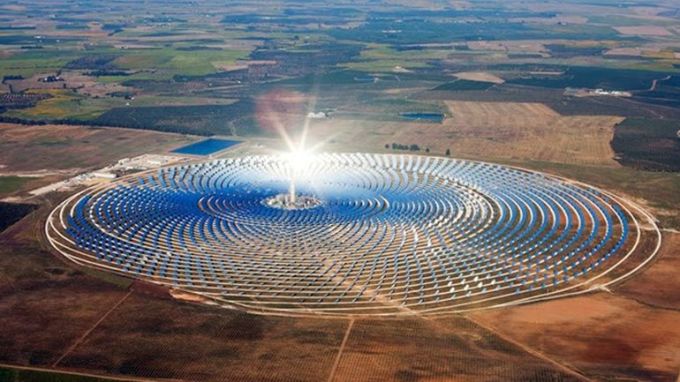
Noor-1: 500,000 reflective mirrors heating tubes full of molten salt that can generate electricity for up to three hours after new sunlight has stopped being absorbed.

Morocco will meet these numbers with a combination of wind, hydro, and solar, with solar seen as having the most potential. The centerpiece of this is the Noor-1 Concentrated Solar Plant, which recently supplanted Abu Dhabi’s Shams-1 as the world’s largest CSP facility, with a nameplate capacity (the amount of energy a facility can produce at any one time) of approximately 160 mW/h. Once this four-stage project is complete, its nameplate capacity will be 580 mWh, which will not only meet Morocco’s needs, but also enable the kingdom to pursue options like selling excess energy to its African neighbors.

In a perfect world, Morocco’s prodigious solar output would link up to the energy-hungry economies of Europe, but this goal has repeatedly run into complications. Nevertheless, Morocco remains committed to expanding its renewable portfolio. One of the reasons for this persistence is the fact that Morocco’s flagship project, Noor, still has one extremely serious investor: ACWA, Saudi Arabia’s largest utility corporation. Even while negotiations with Europeans were floundering, Morocco’s solar commission tapped ACWA  to implement 350 mW worth of power production in Noor-2 and Noor-3.

So now we have come full circle, back to the Saudis and their ambivalent role in both supporting and resisting the potential of renewable energy sources. In the next entry, we will attempt to reconcile these conflicting strategies.

* How Concentrated Solar Power production works:

Most western readers will be most familiar with solar power as a product of photovoltaic cells, which use sunlight to produce a chemical reaction in synthetic paneling that produces DC electricity which flows onto an electrical grid. Concentrated Solar Power works quite a bit differently:

Print

The sun bounces off an array of mirrors, which reflect the light back towards a central heating tower. This tower is circulating a semi-solid form of salt or other pure chemical extract. The intense solar heat renders this semi-solid molten, and the molten material is pumped through the CSP’s piping system, where it superheats water into steam, which then spins turbines and produces electricity much as one would find in a traditional carbon-burning power facility.


A Tale of Two Ports: India in Iran and China in Pakistan (II)

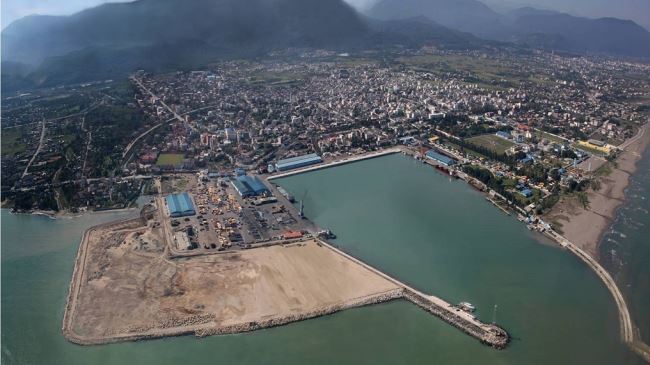
Chabahar port, Iran

Continued from last time, we looked at (I) the logic behind Indian and Chinese port investment strategies in southern Eurasia, and (II) how China’s strategy has found expression in the Pakistani port of Gwadar. Now we turn to India’s competing (yet complimentary) port strategy in Iran.

Chabahar: India actually began investing in the Iranian port of Chabahar back in 2003, during the halcyon days of Iran’s president Muhammad Khatami, when Iran appeared to be on a straight path back to the community of nations. The dueling banjos of the Ahmadinejad and Bush eras obviously put a damper on this trend, but the transformational aspects of the Iranian nuclear deal have put investment back on the table. As of June, 2015, India and Iran signed a memorandum of understanding for India to drop a new initial investment of $85 million into enhancing the port’s capabilities. It’s ironic that what began as an inocuous port investment in 2003 has, by 2015, become an event dripping with international importance due to China’s investment in Gwadar, Pakistan, a mere 72 kilometers away.

Compared with Gwadar, which is a largely finished project, the particulars of Chabahar’s port capacities remain speculative; the initial phase won’t be complete until the end of 2016, and the $85 million Indian investment is the product of a memorandum of understanding, which is a more modest international agreement than a formal treaty or trade pact. Nevertheless, all parties involved seem pretty damned happy about the deal.

Many maps of “One Belt, One Road” exist, but I find this one particularly helpful because it charts Chinese designs not purely by aspiration, but by following the money on where China has actually placed its chips in the gamble to create stable trade nodes along the belt. Note that although many older OBOR maps included India as a prime overland stakeholder, a look at actual Chinese investment proves that India is largely being bypassed in favor of Bangladesh, Sri Lanka, Pakistan, and Iran.

In any event, India isn’t planning to militarize Chabahar any more than China has overtly militarized Gwadar. Rather, India plans to use Chabahar as a crucial link in its own economic plans for Eurasia. Remember part one of this series, where I outlined the essential problem India faces when trying to full engage with Eurasia by terrestrial routes: Pakistan, and Pakistan’s deep integration into China’s proposed One Belt, One Road economic model for Eurasia. Even though India’s infrastructure has some serious gaps to bridge, it is far too sophisticated a country to be dependent on rivals for its overland trade capacity. Therefore, India has developed its own proposed trade route through Eurasia: the North-South Transport Corridor (NSTC).

The North-South Transport Corridor, with termini in Russia and India by way of Iran and Azerbaijan.

While China has conceived of an east-west axis to facilitate Eurasian trade and energy circulation, India conceives of a slightly shorter northwest-by-southeast route that connects western India with the core territories of western Russia. Make no mistake, while China’s strategy is largely to facilitate the circulation of goods first and energy second, India conceives of this as an energy highway; Russia is the world’s largest natural gas producer, Iran could become the second, and Azerbaijan is a robust oil and gas player. Since India can’t get this corridor constructed all the way through Pakistan, the closest actual overland terminus of the NSTC would naturally be in Iran. Now, with Iran’s reintegration into world financial markets on the cusp of becoming a reality, the NSTC can finally get this southern terminus, twelve years in the making. If this pipeline finally supplies India with enough natural gas to begin at least a marginal transition away from its ailing coal-addicted power grid, Chabahar could be a global game changer where climate change is concerned.

Compared with China’s investment in Gwadar, with all of the baggage that comes from building in Baluchistan on top of a multi-billion dollar price tag, India’s modest $85 million investment in (comparatively) peaceful Iran’s already-thriving port at Chabahar looks like a pretty good deal. The big difficulty here, however, is once again Pakistan. While Pakistan hasn’t raised any official objections over India’s Iranian investments, remember that Pakistan has pushed China to envision Gwadar as a dual-purpose facility with military potential. Should another India-Pakistan conflict breaks out (which amounts to a “not if but when” question), Pakistan might be able to use its port capabilities to completely neutralize India’s civilian commercial infrastructure at Chabahar.

But this might not keep Indian planners up at night, because Chabahar is part of a long game that, as we’ll see, gives Pakistan much more to worry about than its neighboring rival.

Next: The unlikely winner of the port game is…


A Tale of Two Ports: India in Iran and China in Pakistan (I)

Gwadar port on Pakistan’s Baluchi coast.

As I have argued recently, the key to understanding modern mainland Eurasia, whether it means Putin’s revanchism, India’s naval buildup, or China’s seemingly omni-directional infrastructural explosion, lies in appreciating how much Asian leaders think in terms of overland trade routes. To American readers, this is actually a pretty foreign concept: the nation’s geography, with the exception of a few transnational corridors like I-5, encourages maritime economics. For Eurasian planners, however, overland trade alone could, theoretically, connect more than eighty countries. To make anything like this remotely possible, however, a few countries absolutely have to be on-board.

Look at this map from east to west and pretend you’re China: what would it take to get something by land from Beijing to Paris? Due to the existence of the Black and Caspian Seas, you’ve got two routes at your disposal: a northern one, which is heavily dependent on Russia, and a southern one, running through many more countries…but which cannot exist without Iran. As soon as sanctions against Iran became lifted, China has therefore rapidly accelerated its preliminary investments in Iranian road projects, linking the country to China’s close ally, Pakistani. For China, which has the conjoined interests of cheap exportation of goods and secure importation of energy, bringing Iran online was a virtual godsend…but until sanctions relief kicked in, China had to work on an overland strategy which briefly leapfrogged Iran when it was an economic pariah. This leapfrog maneuver required developing a port infrastructure that kept a southern trans-Eurasian route in place.

Now, look at this same map from India’s perspective, with the assumption you also wanted to move goods north or northwest, but keeping in mind that Pakistan is a nuclear-armed rival that is utterly unreliable as a secure host for any purely overland trade route. The solution, therefore, is to leapfrog Pakistan.

Framing the scenario like this, it makes logical, if comedic, sense that India and China, Eurasia’s two rising powers, have pursued parallel but competitive strategies that have led to each one dumping money into massive port structures that are within sixty miles of one another yet divided by an international border. Enter India investment in a port in Iranian Chabahar and China doubling down on its longstanding development of Pakistan’s deep water port at Gwadar.

Gwadar: China has been investing in Pakistan for many years, for a variety of reasons. Folks who prefer the 40,000-foot view can look at it as a pure geopolitical move of counterbalancing versus India (or even the U.S.). On a more local level, Chinese investment in Pakistan can be summed up more banally: China borders Pakistan, they’ve already built a highway connecting the countries, and Pakistan gives China access to a port on the Indian Ocean. Such an investment is probably worth it in its own right. Of course, it doesn’t hurt that creating a Chinese super-port at Gwadar scares the shit out of India and the United States.

Overhead of Gwadar’s prospective final form.

Gwadar is held out as a prime example of the much-feared Chinese strategy referred to as “String of Pearls” by American intelligence analysts. This may be an overwrought way of describing the naval strategy of an ascendant superpower: get money, get power, build boats, project power. The British did it, the U.S. did it, the Soviets did it (without acknowledging the “money” step), and now China is doing it.

Histrionics aside, however, Gwadar is still a formidable undertaking, as the above diagram indicates. It has cost billions dollars to complete this project, but the result has been a dual-bay deep water port behemoth that, while not explicitly a military base, is large enough to let any current Chinese ship or submarine (excluding maybe the Liaoning aircraft carrier) refuel.

The geopolitical implications of Gwadar depend who you ask. From a Chinese perspective, it is a miracle port that secures access to natural resources while helping to boost the rule of law in the Indian Ocean, on the theory that such a port will function as a new trade hub for the entire region, as the below graphic taken from a pro-Chinese policy paper suggests:

All sea roads lead to the remote Pakistani coast…?

From Pakistan’s perspective, as this policy paper written by a Pakistani army officer makes clear, Gwadar is also a way to defeat India’s attempt to “encircle” Pakistan (a worldview at odds with the map I showed above) by creating a military port that could, if need be, linearly cut the Arabian Sea into eastern and western zones, thereby controlling the maritime flow of Middle Eastern oil in ways that would hinder any attempts at an American-backed regional security architecture. Indeed, accounts suggest that Pakistan, not China, has been the main driver to make Gwadar an active naval base (as opposed to a multi-functional port).

From a third perspective, however, Gwadar might be something of a white elephant, because it is a classic example of a tone-deaf, top-down infrastructural mega-project that does not enjoy local support. Gwadar is the coastal littoral of Baluchistan, a region prone to armed insurrection due to a hellacious number of grievances between local Baluchis and the Pakistani government in Islamabad. I doubt Chinese officials are losing any sleep over murdered or disappeared Baluchis, but they still have reason to take the Baluchi insurrection seriously: Gwadar is deep in undeveloped Baluchi territory, and any attempt to connect the port overland to Chinese territory will require building rail lines, pipelines, and heavy duty roads that will be vulnerable to guerrilla attack.

But in the grand scheme of things, is India’s port strategy any better? We’ll find out.

Next up: India’s port at Chabahar and the port feud’s unlikely winner.

Implications of the Iran Deal: Saudi Edition (II)

Saudi troops in the Yemen campaign.

Proxy Warfare:

Iran’s foreign policy is shaped by the imperative to pursue regional influence while skirting America’s longstanding containment regime. This has led to a strategy of sending Iranian cadres to aggrieved Shiite communities throughout the region, then transforming these communities into pro-Iranian paramilitary organizations along its periphery. It has worked in Lebanon and Afghanistan, it is working in Iraq, and it might be working in Yemen.

The U.S. has generally been unable to stop this approach, but then again, the U.S. doesn’t have to live next door to it. The Saudis do. Therefore, a cornerstone of Saudi foreign policy has been stymieing Iran’s proxies. As Iran’s power waxed ascendant following the overthrown of Saddam Hussein (see Vali Nasr’s excellent, prescient description of this trend, the Shia Revival), the Saudis’ efforts have only intensified. The Iranian nuclear deal may have brought some newfound peaceful rhetoric to regional affairs, but it has not tamped down Saudi’s reactionary tendencies. Indeed, Syria and Yemen indicate that Saudi’s willingness to aggressively confront Iranian influence may be reaching a fever pitch.

Bahrain 2011: The tiny archipelago of Bahrain is a Sunni monarchy deep within Saudi Arabia’s security orbit that rules over a restive Shiite majority. In early 2011 these Shiites erupted in anti-government protests against minority rule. The Saudis responded by invading the kingdom and crushing the uprising, with the tacit implication that the Saudis were forestalling a pro-Iranian regime change. The curious thing here, as far as I can find, is that Iran had offered Bahrain’s Shiites moral support, but little in the way of material backing, either before or after the Saudi invasion. Indeed, the protesters took great pains to indicate that they were only interested in non-violent resistance. However, Hezbollah, almost certainly speaking on Iran’s behalf, has made it clear that military support could be forthcoming if the Bahraini opposition asked for it. If this occurs, we already know how the Saudis will respond.

Jabhat al-Nusra fighters, a Saudi-supported al-Qaida affiliate fighting against the Assad government.

Syria 2015: Like most Middle Eastern states, Saudi Arabia has had its fun in the playground of wartime Syria, supporting Sunni rebel groups against Bashar al-Assad’s Iranian-backed government. However, prior to 2015 this support was notably halfhearted (partially as a result of Saudi’s fear that its subjects were funding ISIS as private citizens). This changed in the spring of 2015, when the kingdom announced a concerted strategy to back anti-Assad rebels.

The Syrian civil war is too complicated to describe in a single paragraph; that said, it is noteworthy that, just as Iran and the U.S. reach an agreement that many believe could lead to a negotiated solution in Syria, Saudi Arabia is assembling a coalition to extirpate Assad’s regime entirely.

Yemen 2015: Starting in 2003, a significant contingent of perpetually-benighted Yemen’s Shiite minority–who comprise about 1/3 of the country– has rebelled against the national government. They’ve named themselves the Houthis, after the movement’s assassinated founder. Upheavals caused by the Arab spring have sent the unstable Yemeni state into a death spiral, to the point that in early 2015 the Houthis invaded Sana’a, the capital, and dissolved parliament. At this point, opinions differ as to whether or not the Houthi insurgents are genuine proxies of Iran, or simply Shiite fellow travelers who enjoy Iran’s logistical support in pursuit of purely local objectives. Iran hasn’t helped clarify the issue, since it has admitted to sending military advisers to the area and gloated about the country’s reach on the floor of the Iranian parliament while also claiming that it isn’t leading the Houthi uprising towards Iranian ends. For the Saudis Iranian activity isn’t so ambiguous, and they have responded by assembling a multi-country Sunni coalition to militarily crush the Houthi rebellion.

At the moment, this is the hottest point in the Saudi campaign to reduce Iranian regional  influence, because Yemen is the only battleground where Saudi forces are directly attacking perceived Iranian proxies. Such a prolonged military commitment in Yemen could be devastating for the Kingdom as it extends itself financially along other fronts. But at the moment, the Saudis seem to think the benefits of thwarting Iran are worth it.

I’ll note that Iran’s most notorious client groups–Lebanese Hezbollah (there’s more Hezbollahs than you’d think) and the powerful Shiite self-defense of Iraq–have been left off this list. That’s because they are so inextricably linked to the overall fates of their countries that they will be dealt with in turn when Lebanon and Iraq are discussed.